Is a dual fuel heat pump worth it in Rhode Island

New system or replacementHeat PumpRhode Island
Step 1 of 2

What ZIP code is the job in?

Yes, for most homes in Rhode Island. A heat pump alone struggles once temperatures drop into the teens and below, which happens through a normal Rhode Island winter, and it leans on electric backup heat to make up the difference. Electric backup costs more to run here than almost anywhere else in the country. Dual fuel solves that by switching the system over to a gas furnace once the outdoor temperature gets too low for the heat pump to work efficiently, and most Rhode Island homes already have a gas line to run one. You still get the heat pump's efficiency for the mild months and the shoulder seasons, plus the muggy summers it was likely sized for in the first place, and you get gas heat for the cold stretch instead of paying electric resistance rates to stay warm. The tradeoff is the cost of adding a furnace and the controls that switch between the two systems, which only pays off if the setup and switchover point are sized correctly for your house.

A gray outdoor air conditioner condenser unit on a concrete pad beside a house with horizontal lap siding and a stone veneer base, with a conduit running to a wall-mounted disconnect box and shrubs and evergreen trees to the left.

Heat pump, above the balance point

Down to around freezing or a bit lower, the heat pump covers the house on its own. It pulls heat from the outside air and moves it in, and the gas furnace stays off. This is where a heat pump runs cheapest, since it isn't burning anything or drawing on backup heat strips.

An outdoor air conditioning condenser unit sits on a concrete pad beside a white horizontal-siding house, with a gray electrical disconnect box and insulated refrigerant lines on the wall, mulch and green shrubs to the right, and a concrete slab in the foreground.

Heat pump, below the balance point

Once the outdoor unit can't keep up, usually somewhere in the teens or lower, dual fuel switches the gas furnace on and lets the heat pump step back. The furnace carries the coldest stretches of a Rhode Island winter, which is the point of pairing the two in the first place.

What happens in your house when it gets cold

On a cold January night, listen for the heat pump straining to keep up, running long stretches without the house ever feeling quite warm enough. Check your thermostat or utility app if it shows outdoor temperature or system mode, you may see it switched to backup heat on its own. That's the electric strip heat picking up what the heat pump can't deliver below the mid-30s. If there's no furnace to take over at that point, the electric bill for that stretch will run higher than it needs to, every winter, for as long as the system is set up that way.

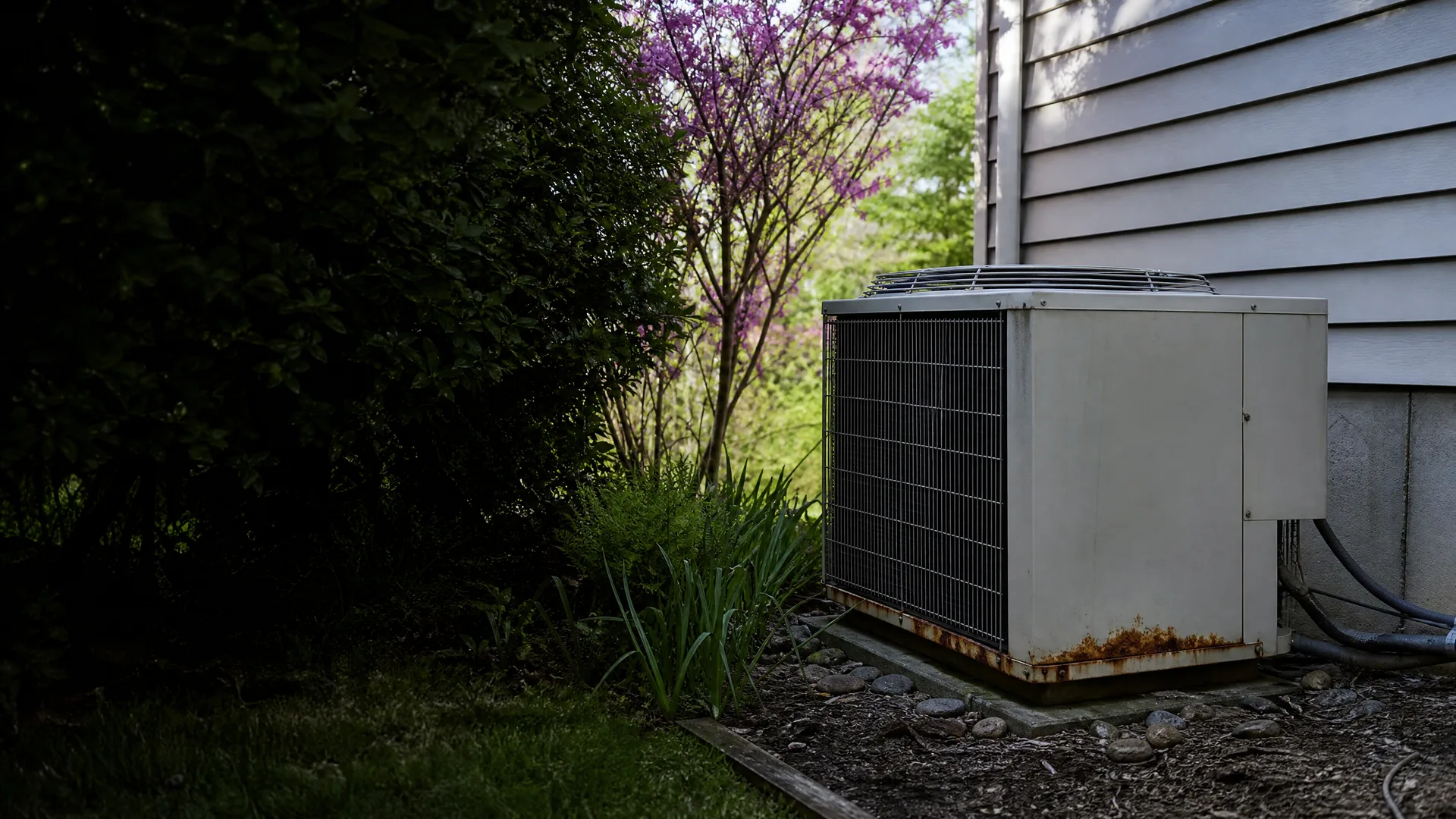
An outdoor air conditioning condenser unit with rust streaks sits on a concrete pad beside a light-colored lap-sided house, surrounded by shrubs, gravel and a flowering tree.

You're out raking the side yard in April when you stop by the outdoor unit. The rust along its base has spread since last year, a thin orange line creeping up from the ground where snow sat against the housing all winter. The fan looks fine, the unit still runs, but the cabinet is going soft at the corners. You crouch down and press a thumb against it. Behind you, through the kitchen window, you can see the thermostat on the wall, set back down to a normal spring temperature now that the heat pump isn't fighting January anymore. You make a note to ask someone about it before next winter, then go back to raking.


A woman in a cream sweater and jeans stands in the open doorway of a white stucco house, holding the dark door, while a man in a dark quilted jacket seen from behind walks toward the entry past potted plants.

How the switchover actually happens

Inside the thermostat or a control board mounted near the furnace, there's a setpoint called the balance point. It's programmed to the specific heat pump and furnace, not guessed at. When the outdoor temperature drops below that point, the system shuts the heat pump's compressor off and fires the gas furnace instead. You won't feel the switch. There's no draft of cold air while it happens, no delay where the house sits unheated.

Getting that balance point set right is the part that separates a dual fuel system that saves money from one that just adds cost. Set it too high and the furnace kicks on when the heat pump could still handle the load cheaply. Set it too low and you're paying for electric strain the heat pump wasn't built for. A contractor who installs these year-round in Rhode Island, matched to your house once you request service, will know the setpoint that actually fits your equipment and your ductwork, not a number pulled from a manual.

A living room corner with a beige sofa and cushion, a round wooden coffee table holding a pale ceramic vase of eucalyptus stems and a wooden bowl, and a curtained window with a potted plant above a latticed radiator cover in the background.
A gray outdoor condenser unit on a concrete pad beside a house with horizontal lap siding, with a metal disconnect box and refrigerant lines on the wall, river rock and mulch to the sides, and a green shrub at right.

A heat pump that's kept up with

Gravel around the base, clear conduit, nothing growing into the cabinet. Air moves through the fins the way it's supposed to. A unit kept this way can switch between electric and gas without added strain, and the balance point the installer set still holds.

A dirty outdoor air conditioner condenser unit with debris on its coil grille, sitting on a concrete pad beside a light-colored horizontal siding wall, with bare dirt ground in front and a shrub at right.

A heat pump that's been ignored

Leaves and dirt packed into the grille choke off airflow before the refrigerant inside ever gets a chance to do its job. A heat pump working that hard switches to the gas furnace sooner than it should, and you pay for backup heat you didn't need yet.

How does the furnace know when to kick in instead of the heat pump

You're not out there watching the equipment switch over, so it's reasonable to wonder what actually tells the furnace to take over from the heat pump. It isn't someone flipping a switch, and it isn't guesswork on the system's part either. There's a specific trigger behind it, set during installation, and it's worth knowing what that trigger is and where it lives.

A temperature sensor tells it, not a timer or a guess

An outdoor sensor wired to the control board reads the actual temperature at the unit, and that reading gets compared against the balance point set during installation. When the outdoor air drops below that number, the board locks out the heat pump's compressor and fires the furnace instead. It's a straightforward handoff, not a blend of the two running together. The furnace doesn't ease in while the heat pump tapers off. It's one or the other, decided by that sensor reading alone. If the balance point was set correctly for your house, the switch happens on its own and you'd only notice the furnace sound replacing the heat pump's. If it was set wrong, the furnace either kicks in too early, raising your bill for no reason, or too late, leaving the heat pump to strain through cold it can't handle well.

An outdoor air conditioning or heat pump condenser unit on a concrete pad beside a house with horizontal vinyl siding, a gray electrical disconnect box and conduit on the wall, and a concrete walkway in the foreground.
Before you get your heat pump installation
A gray outdoor condenser unit on a concrete pad beside a house with gray lap siding, connected by conduit and refrigerant lines to a wall-mounted disconnect box, with a green shrub and mulch bed at left.
After you get your heat pump installation

Matched to your heat pump job

A furnace and a heat pump run off a single balance point, programmed to your equipment and your house, not to a guess. Getting that number right, and getting the furnace and heat pump talking to each other correctly, is the kind of work that goes wrong in small ways you won't notice until a February electric bill shows it. A contractor local to Rhode Island who installs these year after year has seen which setups hold up through a real winter here and which ones leave the furnace cutting in too late or too often. Rhode Island's gas access and its electric rates make dual fuel worth getting right rather than close enough. One licensed contractor reviewing your current heat pump and your house can tell you whether adding a furnace makes sense for what you have, instead of you guessing from general advice that wasn't written for your equipment or your street.

A two-story house with light beige horizontal siding, a gabled roof, a small covered front porch with dark door, and shrubs along the foundation, set behind a mown lawn and wet sidewalk with large leafy trees on both sides.

Summers here run sticky, and the number behind that is a dew point averaging 61°F across June, July and August, according to NOAA climate data for Rhode Island. That's heavy air, the kind that feels warm even when the thermometer doesn't back it up. Your heat pump has to pull that moisture out before the house feels comfortable, not just drop the temperature. On a muggy stretch, expect it to run longer and more often than a summer with drier air, and to keep running after the thermostat hits its number, working on the humidity you can still feel on your skin.

NASA POWER T2MDEW county cells weighted by homes

Dual Fuel vs. Heat Pump Alone

Dual fuel setup

  • The gas furnace takes over automatically once outdoor temperatures drop below the balance point, so you're not running electric backup heat through the coldest stretches of winter.
  • Gas is cheaper than electric heat in Rhode Island, so the months when the furnace does the work cost less than a heat pump alone would during a cold snap.
  • The heat pump still handles cooling all summer and covers heating down to around freezing, so the furnace only runs during the coldest weeks.
  • Installation means setting up two systems to hand off to each other correctly, which takes a contractor who's done the wiring and the balance point setup before.
  • You need a working gas line and furnace already in the house, or the cost of adding one, since dual fuel only works where both systems exist.

Heat pump alone

  • Electric backup heat strips take over below the balance point instead of a furnace, and electric heat costs more here than gas does.
  • There's no second fuel source or gas line to maintain, which simplifies the install if the house doesn't already have gas.
  • On the coldest Rhode Island nights, the heat pump leans harder on backup heat, and the electric bill reflects that during those weeks.
  • One system to install and service instead of two, which can mean a more straightforward setup if gas isn't already run to the house.
  • Without a furnace to hand off to, the heat pump and its backup heat are doing all the work through every winter month, cold snap or not.
A woman with shoulder-length brown hair wearing a beige knit cardigan sits in a gray upholstered armchair near a window, looking off to the side with a slight smile, with bookshelves blurred in the background.
A woman and a child wrapped together in a knitted gray blanket on a couch, with the child's head resting on her shoulder and a lit table lamp and houseplant in the background.

Power costs 29.48 cents per kilowatt-hour statewide

At 29.48 cents per kilowatt-hour, every hour your heat pump leans on electric backup instead of the gas furnace shows up on your bill. That's the number that makes the switchover point matter so much in your house. Get it set right, and the furnace carries the cold stretches gas has always carried.

EIA-861 2025 statewide residential average

Where this leaves you

  • A dual fuel setup is worth it for most Rhode Island homes because it avoids running expensive electric backup heat through the coldest months.
  • The heat pump covers cooling all summer and most of the heating season on its own, down to around freezing or a bit lower.
  • The gas furnace takes over automatically below the balance point, so you're not paying electric rates during the stretches that would cost the most.
  • Getting the balance point set correctly for your specific equipment and house is what makes the whole arrangement work as intended.
  • A unit that's rusted at the base or clogged with debris can throw off that switchover even when the balance point is programmed right.
  • Where you land depends on your furnace, your heat pump, and how well the two are set up to hand off to each other.

Rhode Island winters drop into the teens and below often enough that a heat pump alone can't carry the house through them without help. Pairing it with your gas furnace gives you a way around that. The heat pump does the cooling all summer and handles most of the winter on its own, since it only struggles once temperatures fall toward freezing and below. Below that point, the furnace takes over, and because gas runs cheaper than electric backup heat here, you're not paying the highest rate on your bill during the coldest nights of the year.

None of that happens automatically just because you own both machines. The furnace and heat pump hand off to each other at a balance point, and that number has to match your specific equipment and your house. Set wrong, you end up running electric backup more than you need to, or the furnace kicks in earlier than it should. A unit that's rusted at the base or packed with yard debris can throw off that handoff too, even with the balance point programmed correctly, because the heat pump can't pull air the way it's supposed to.

So the honest answer is it depends on the install, not just the equipment. Two houses with the same furnace and the same heat pump can end up with different bills if one has the balance point set right and the other doesn't. That's the part worth getting right before you decide the setup isn't working for you.

A gray-haired man in a dark sweater sits on a light gray sofa in a living room, looking toward a sunlit window with trees outside.
A gray-haired man in a dark blue sweater sits on a light gray sofa in a sunlit living room, looking off to the side, with a potted plant, shelving unit, and large glass doors behind him.
A bearded man with graying hair in a dark green sweater sits on a sofa in a living room, looking off to the side, with a sliding glass door and a dim kitchen doorway behind him.
A gray-haired man in a dark knit sweater sits on a light gray sofa in a living room, looking toward a sunlit window, with houseplants, a lamp, and framed art in the background.

A heat pump pro near you

A dual fuel setup makes sense in Rhode Island because of two things: the heat pump handles the muggy summers well, and the gas furnace takes the coldest nights off its hands so you're not paying 29.48 cents per kilowatt-hour to stay warm. Getting the balance point set right is what makes it work, and that's where a local contractor who installs these systems regularly earns their keep. Request a match and one licensed contractor near you will reach out, so you're dealing with a single call, not several.

Find a licensed heat pump pro

The pro who reaches out is licensed in Rhode Island.

No fee to send it, and nothing to sign.