A white picket fence runs along a grass lawn in front of a row of similar gabled houses with siding, beneath overhanging leafy tree branches.

AC Installation in Warwick, RI

Tell us about the job

Takes about a minute. No obligation.

New system or replacementCentral ACKent County, RI
Step 1 of 2

What ZIP code is the job in?

Electricity here runs 28.65 cents per kilowatthour

Rhode Island's electric rates are among the highest in the country. Every kilowatt this system pulls costs more here than it would in most states, so a unit's efficiency rating matters more in Warwick than it would somewhere with cheaper power.

The rating on the system is what you're buying

When you compare units for a Warwick install, the SEER2 number tells you how much cooling you get for the electricity you put in. With rates this high, a higher rated system earns back the difference on every bill it runs.

2 months
July through August, your air conditioner is on duty
80°F
the average summer afternoon it cools against
5 hail events
in ten years, and hail bends the fins on outdoor coils
13.4 SEER2
the federal minimum any new unit must meet
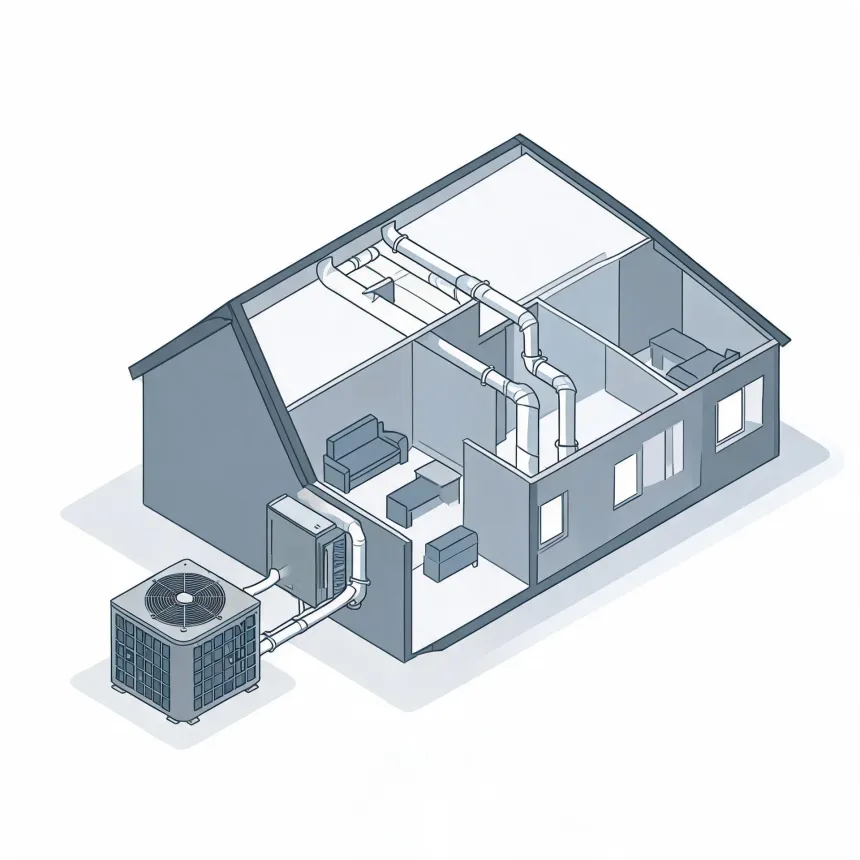
Isometric line illustration of a cutaway house showing interior rooms with ductwork, an indoor air handler, and an outdoor condenser unit connected by lines, on a white background.
Your air conditioner works hardest from July through August.

NOAA nClimDiv, 1991–2020 normals

Cooling in Warwick starts in July.

Have the new system installed in June, before the heat shows up what the old one can't do.

Half the homes in Kent County were built in 1967 or earlier. A new system has to work in the house that's actually there.

Half the homes here were built by 1967
Cooling runs July through August
Summer afternoons average 80°F
Most of Kent County doesn't heat with electricityGas heats just over half the homes here. Oil heats another third.

Cooling runs about two months here, July and August, with afternoon highs around 80. That is not much strain on a system. Kent County winters ask more of a heating system than its summers ask of an AC. So the install does not call for the biggest or most advanced unit on the lot. A correctly sized system from a solid, well-known line will keep up without trouble. Put the money into sizing it right for the house and having it put in correctly.

Any system installed here has to clear 13.4 SEER2

Kent County sits in climate zone 5A, and any split-system air conditioner under 45,000 Btu/h built for installation here has to meet a federal minimum of 13.4 SEER2. That sets the floor. A contractor can tell you what qualifies for the federal tax credit on top of it.

Find a contractor
An outdoor air conditioning condenser unit mounted on a concrete pad surrounded by gravel, photographed against a partly cloudy blue sky.

Sized for the house, not the old unit

Before a new system goes in, a contractor should run a load calculation on the house as it is now, not match the tonnage of whatever is coming out. A house built decades ago may have had windows, insulation or additions done since, and any of those change what the house needs today. The ductwork already in place is also whatever was standard when the house went in, and the new system has to move air through it, so it is worth having that checked alongside the load calc. This is a sizing question, not a strain question. Getting the number right is what the installer should be doing regardless of how hard Warwick summers push the system.

Bigger isn't better

An oversized air conditioner cools the room fast and shuts off before it pulls the moisture out of the air. The house ends up cold and damp at the same time. Meanwhile the compressor is cycling on and off all day instead of running a full cycle. That short cycling wears on a compressor faster than a system sized right.

The load calculation is the job

A contractor works out the right size by running a load calculation on the house itself. Square footage, window area, insulation, ceiling height, which way the house faces all go into that math. The old unit's size is not part of it. If the old system was wrong for the house, matching its tonnage just repeats the mistake.

An overhead view of a residential air conditioning condenser unit mounted on a concrete pad next to a house with vinyl siding.

A higher-efficiency unit would save about $40 a year to run in Kent County compared with a new unit at the federal minimum.

  • A higher-efficiency unit$260 a year
  • A new unit at the federal minimum, 13.4 SEER2$300 a year

Estimates for a typical Kent County home, from EIA household energy data, Rhode Island fuel prices and NOAA climate normals. Your home will differ.

Installation day starts with the old system coming out, indoor and outdoor units both, along with the old line set if it's not being reused. A tech recovers the refrigerant from the old lines before cutting anything loose, since it's not legal to vent it into the air. Once the new outdoor unit is set on its pad and the indoor coil is in place, the lines get run. The system gets evacuated to pull any moisture and air out, then it's charged to the manufacturer's spec for the length of line used. Startup comes next. The tech checks refrigerant pressures, checks the temperature split between the air going in and the air coming out, and makes sure the condensate drain is actually draining. A system that's sized and installed right settles into a steady run once it's started, no short cycling, no struggling to hit temperature. Most houses see the whole job done in a day, start to finish.