Electricity here runs 28.65 cents per kilowatthour
Rhode Island power costs more than it does in most states. A mini split that's efficient to begin with keeps that rate from turning into a bigger bill every month it runs.

Takes about a minute. No obligation.
Rhode Island power costs more than it does in most states. A mini split that's efficient to begin with keeps that rate from turning into a bigger bill every month it runs.
Every mini split carries a SEER2 rating, and the higher it is, the less power the unit draws to do the same job. At this electric rate, the gap between a mid-range unit and a high-efficiency one shows up on every bill, not just the first.
NOAA nClimDiv, 1991–2020 normals
Summers here are short, just July and August, with afternoon highs near 80.
Your mini split won't be working hard, so it doesn't have to be the top model to hold up.




Bristol County is in climate zone 5A, a cool zone where heating carries more of the year's work than cooling does. Any mini split installed here has to meet the federal minimum for a split-system heat pump. That means 14.3 SEER2 for cooling and 7.5 HSPF2 for heating. The rule applies to the unit itself, not how you use it, so it holds whether the mini split is your main heat or backup to a gas furnace. The standard doesn't carve out a separate category for ductless systems. A unit sold here has already cleared the same bar as one going into a home with ducts.
Cooling here only runs July and August, but June is when to get a mini split installed. Get it in before the first hot week and it's working the day you need it, not days after.
Find a contractorGet a load calculation before you pick a unit size. In a house this age, the right size depends on what's actually in the walls, not on square footage alone. A contractor who sizes it to the house, not just the floor plan, is the one you want on this job.
A mini split that's oversized cools the room fast, shuts off, and starts again soon after. It never runs long enough to pull moisture out of the air, so the room feels cold and damp instead of just comfortable. The compressor wears from all that cycling, not from running.
Sizing comes from a room by room heat loss and heat gain calculation, not a chart tied to square footage. It accounts for window area, ceiling height, what's above and below each room, and how much wall faces outside. Houses that look alike on paper can need different size units once that's worked out.
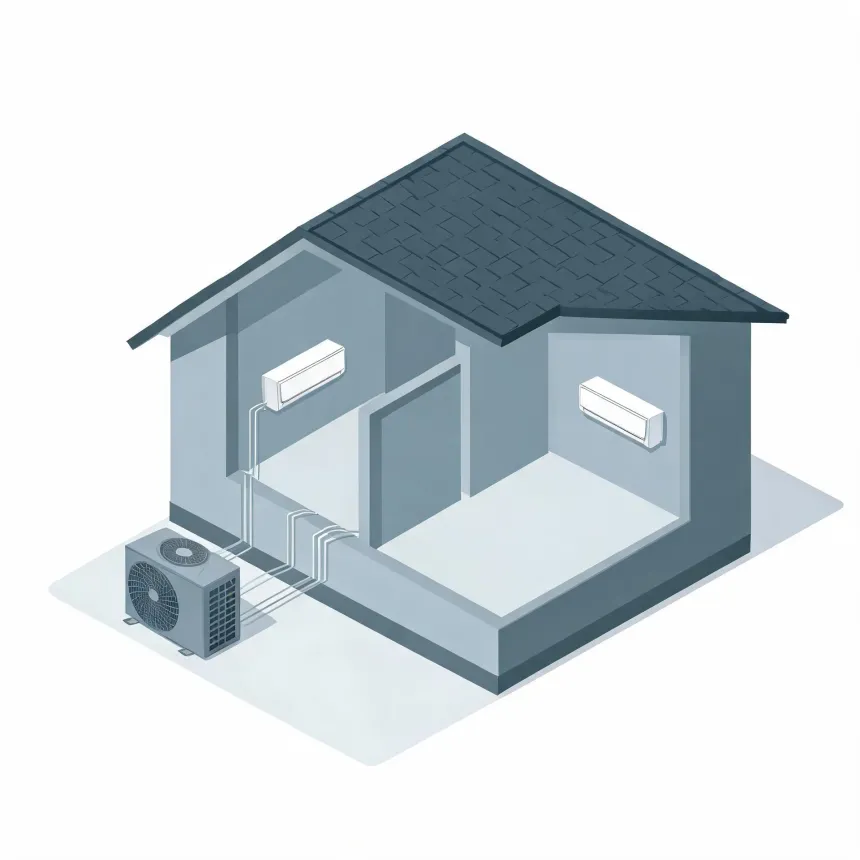
What you pay for isn't just the indoor and outdoor unit. It's the line set that connects them, and the distance and path it has to run matters. A straight shot through a nearby wall costs less labor than a run up through a chase or across the attic to reach the other side of the house. Each indoor head needs its own line set and its own spot on the outdoor unit, so adding a second or third zone adds real cost, not just another small box on the wall. The electrical side matters too. Some units run on the home's existing panel capacity, others need a dedicated circuit added, and that's a different job depending on how far the panel is from where the unit goes. Mounting height and the condition of the wall or roof the outdoor unit sits against can add work before the system itself ever gets touched.
If a furnace or boiler is already doing the heating, the old cooling system is usually just a condenser outside and a coil in the ductwork, and both come out once the mini split is in. If the house is moving away from a window unit or an older ducted system entirely, whoever installs the mini split should disconnect and haul away what it's replacing, not leave it for the homeowner to deal with. Refrigerant in the old unit has to be recovered properly, not vented, so ask if that's included before the work starts. If the old system ran on oil or had its own ductwork, there may be a tank, a line set, or ducts that served no other purpose, worth asking whether those get removed too or just capped off. None of that affects how the new mini split performs, but it's part of the job, not an afterthought to sort out later.