




A white picket fence runs along a mown grass lawn in front of a row of gray clapboard houses with gabled shingle roofs, with large leafy tree branches overhead.

Mini Split Installation in Newport, RI

Tell us about the job

Takes about a minute. No obligation.

New system or replacementMini-splitNewport County, RI
Step 1 of 2

What ZIP code is the job in?

Rhode Island electricity ran 28.65 cents per kilowatthour in 2024, among the higher rates in the country. A mini split earns that cost back through how it's built. Instead of heating or cooling a whole house's worth of ductwork, it sends refrigerant straight to the room that needs it, and the compressor adjusts its speed to match the load instead of switching fully on and off. That matters more here than in a state with cheap power, because every kilowatt it saves is worth more on a Newport bill. Ask what SEER2 and HSPF2 numbers the unit carries before you decide, since those ratings tell you how much of that saved cost actually shows up for you.

8 months
October through May, your system heats
2 months
July through August, it cools
26°F
the average winter night it heats against
79°F
the average summer afternoon it cools against
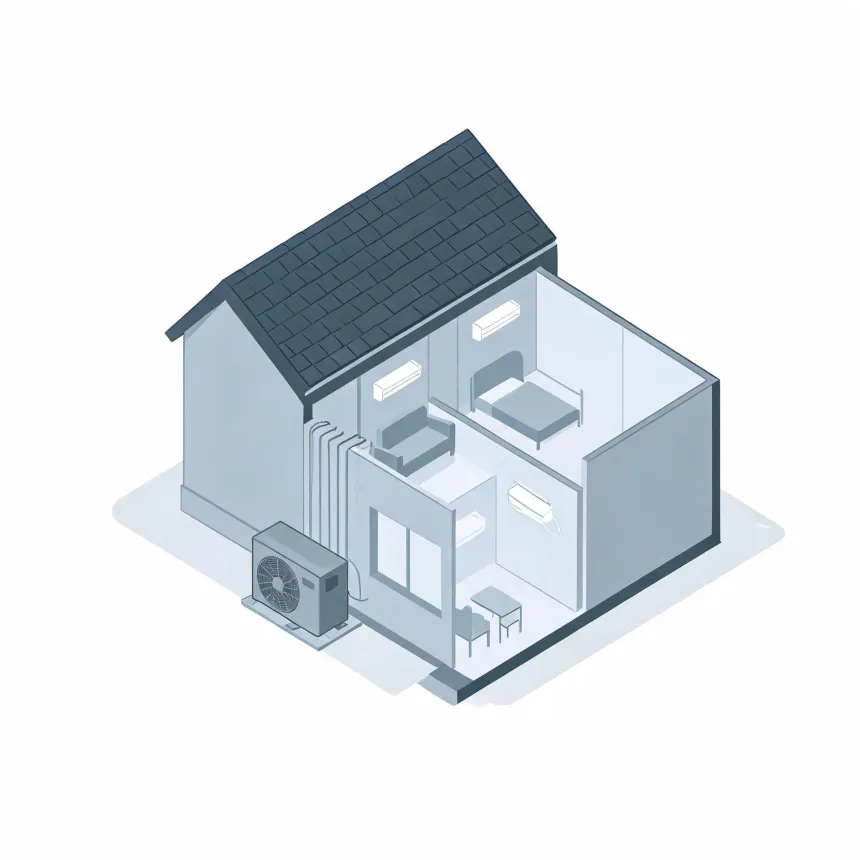
Isometric illustration of a cutaway house with a dark shingled gable roof, showing interior rooms with a bed, chairs and table, three wall-mounted mini-split indoor units connected by line sets to an outdoor condenser unit on a pad outside.
Your system heats October through May and cools July through August.

NOAA nClimDiv, 1991–2020 normals

Cooling here runs about two months, July and August, with afternoon highs near 79.

A mini split in Newport spends most of its life on light duty, so a dependable system matters more than squeezing out the highest efficiency number.

Fuel oil heats most homes in Newport County, which is what makes a mini split different here

43.6% of homes heat with fuel oil
Cooling runs July through August
Summer afternoons average 79°F

Half the homes in Newport County were built in 1963 or earlier. A house that age was almost never designed around central ductwork, which is part of why mini splits get installed here in the first place. But the install still has to work with the house. Wall and ceiling cavities, electrical panel capacity, and where the outdoor unit can sit all depend on how that particular house was built, not on the year. If your system came with the house or you're adding to what's already there, have the contractor check the panel and the wall construction before settling on a unit, since those decide what will actually fit and run well.

A mini split here has to clear Rhode Island's efficiency minimum

Newport County falls under zone 5A, and any split system heat pump installed here, ductless units included, has to meet 14.3 SEER2 for cooling and 7.5 HSPF2 for heating. That floor is already built into what manufacturers sell for this region, and a federal tax credit is available for qualifying equipment. Get the specifics for your install before you decide on a unit.

Find a contractor
A man in a dark shirt and tan work pants, seen from behind, carries a worn canvas tool bag up concrete steps toward a red front door, with a potted evergreen shrub beside the entry.
A beige split-system air conditioner outdoor condenser unit mounted on metal wall brackets atop a stucco wall.

Get it in before July

Cooling here only runs July and August. If you're installing before summer, June is the month to get it done. Wait until the heat shows up and you're booking against everyone else who waited too, with the unit running flat out from day one instead of breaking in under a light June load.

Sizing is worked out room by room

A contractor looks at each room on its own. Square footage, how many walls face outside, window area, what sits above and below it. All of that gets added up into a load number, and the indoor heads get matched to it. Guessing off square footage alone misses the room over the garage or the wall that's mostly glass, and those are the details that change the answer.
Oversized runs worse, not better

A mini split that's too big for the room cools or heats it fast, then shuts off before it's pulled the moisture out of the air. The room ends up feeling clammy even with the thermostat reading right. Undersized has the opposite problem. It runs constantly and still doesn't catch up on the hardest days. The right size runs long, steady cycles instead of short bursts.

The unit itself is only part of what you're paying for. How many zones you want, one head for a single room or several tied to one outdoor condenser, changes the size of the outdoor unit and the amount of refrigerant line a contractor has to run. That line set travels from the outdoor unit to each indoor head through a wall or along it. The distance and the number of bends affect both the labor and how the system performs once it's running. Electrical work is its own piece. A dedicated circuit, and sometimes a subpanel, has to be sized to the equipment, and that depends on what the panel can already handle. Where the outdoor unit can go matters too, since condensation drainage has to run somewhere, and a line set hidden inside a wall costs more to install than one run along the surface in a cover. None of this shows up in the sticker price of the equipment, but all of it decides what the job actually takes.

Installation day starts with the outdoor unit and works inward. The contractor sets the condenser on a pad or wall bracket first, somewhere level with room for airflow on all sides, then runs the line set from there to each indoor head. That line gets connected, pressure tested, and pulled down into a vacuum to clear out air and moisture before any refrigerant goes in, since either one left in the line will wreck the compressor over time. Once it holds vacuum, the system gets charged, the indoor heads go up on their mounting plates, and the electrical and condensate drain get tied in. Before anyone leaves, the system runs through its paces in both heating and cooling so you can feel the airflow and hear what normal sounds like. A straightforward single zone can wrap up in a day. More heads, longer line runs, or electrical work that needs a new circuit or subpanel push it past that.